
10 min read
Are Ants Better Than Urban Planners?

Written by Dr. Ümit Kuvvetli
Founder & Chief Optimization Scientist
What Collective Intelligence Can Teach Us About Public Transport
How do you design a city's bus network?
You analyse demand.
You review existing routes.
You account for budget constraints.
You draw on the experience of planners and operators.
And eventually, you try to find the best possible solution.
But what if the problem is much larger than we think?
Hundreds of stops.
Thousands of possible route combinations.
Constantly changing demand.
Traffic, delays, fleet constraints and driver availability.
In a solution space this large, can human expertise alone really explore enough of the possibilities?
At OW, we often ask a different question:
What if, instead of trying to identify the best solution immediately, we first need to discover solutions we did not even know were possible?
Perhaps ants have something to teach us.

An Ant Cannot See the Whole City. But the Colony Can Find a Path.
A single ant cannot see the big picture.
It does not calculate alternative routes.
It does not know which path is globally optimal.
It simply acts on limited information from its immediate environment.
But when thousands of ants operate together, something remarkably effective emerges.
Some explore new paths.
Better paths are used repeatedly.
Successful options become reinforced.
Weaker alternatives gradually lose importance.
There is no central planner.
Yet through repeated exploration and feedback, the system can discover increasingly effective solutions.
This is the core idea behind Ant Colony Optimization.
Large numbers of virtual “ants” explore different solution alternatives simultaneously.
Good outcomes influence future searches.
The system continues to explore new possibilities instead of becoming permanently attached to a single initial solution.
The relevance to public transport is obvious.
Because the challenge is rarely just about finding the shortest route.

The Shortest Route Is Not Always the Best Route
A bus route may be shorter.
But it may also be consistently delayed by congestion.
Another route may be longer.
But far more reliable.
One alternative may carry more passengers.
Another may provide access to a larger population.
Modern optimization problems therefore cannot evaluate distance in isolation. Multiple operational variables need to be considered simultaneously.
An application involving the tram network in Wrocław provides an interesting example.
Researchers did not evaluate routes based on distance alone. Actual travel times, the gap between planned and observed travel times, speed, population and other operational variables were considered together.
The result was notable.
The optimized alternative achieved a total “effort” value 11.5% lower than the existing route.
The route was also approximately 5% shorter.
But a more important finding emerged.
The existing service had a difference of approximately 4 minutes and 44 seconds between planned travel time and actual operational performance.
In the optimized alternative, that difference was reduced to just 15 seconds.
This tells us something important:
Sometimes the problem is not simply choosing the wrong route. The problem is continuing to plan a system based on a version of reality that no longer exists.

GTFS tells you how the network is designed.
AVL tells you how vehicles actually move.
Passenger data reveals how people actually use the system.
Viewed separately, these datasets show only fragments of the picture.
Combined, they can reveal alternatives that were previously invisible.
This is where OW's approach becomes relevant.
For OW, Optimization Is Not About Choosing an Algorithm. It Is About Exploring a Solution Space.
Ant Colony Optimization.
Genetic algorithms.
Bee-inspired optimization.
Learning-based models.
They are different approaches.
But they share an important principle:
Do not commit to one answer too early.
Explore alternatives.
Reinforce promising solutions.
And continue searching as conditions change.
This is also how we think about optimization at OW.

For us, the question is not:
“Which algorithm is the best?”
The more fundamental question is:
“Which alternatives have you never tested using your city's real data?”
Because algorithms are only meaningful when they are applied to the right problem, using the right data.
GTFSHub™ provides the digital foundation and data integrity required to understand the network.
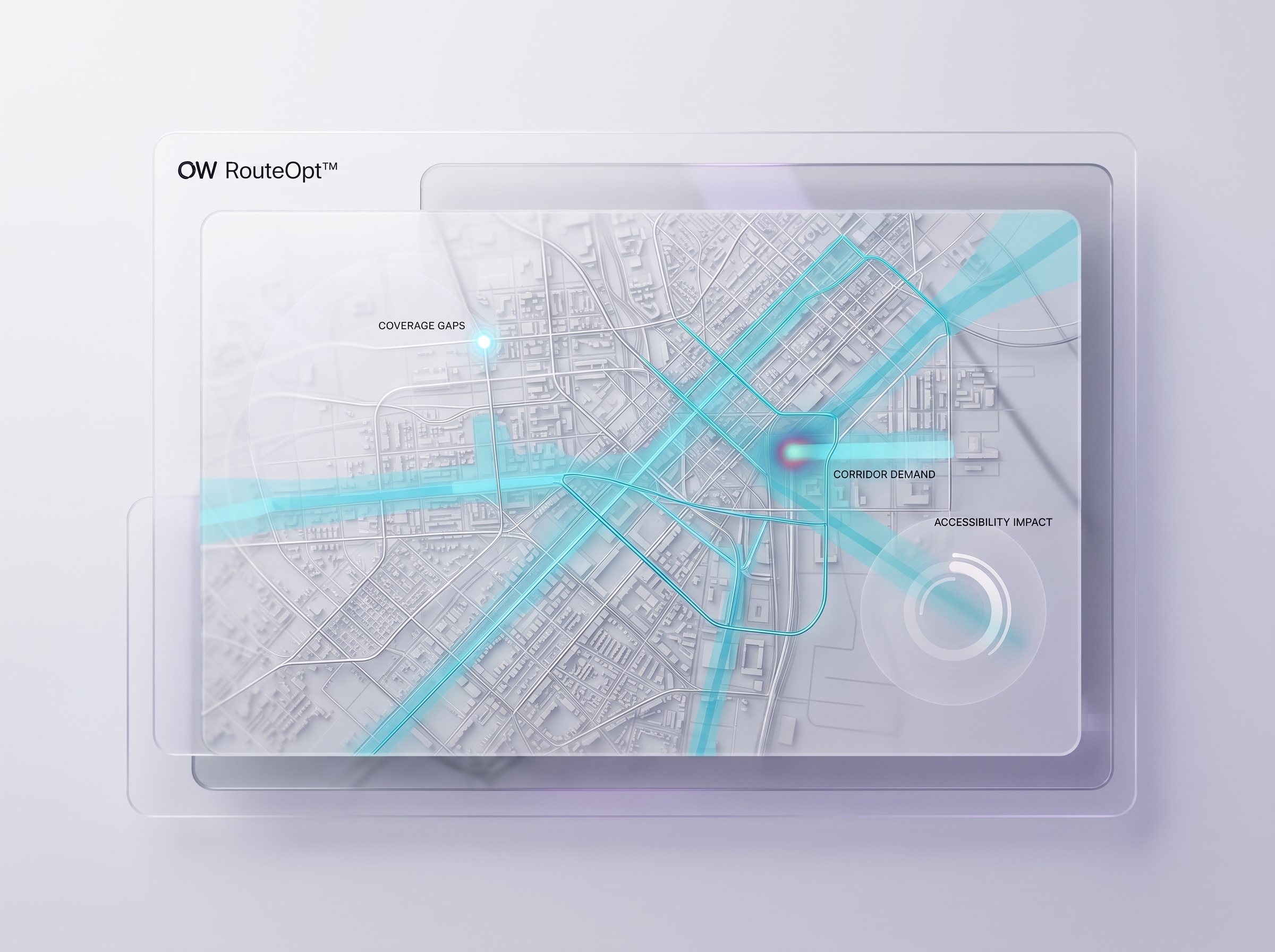
RouteOpt™ enables the exploration of different route and network alternatives.
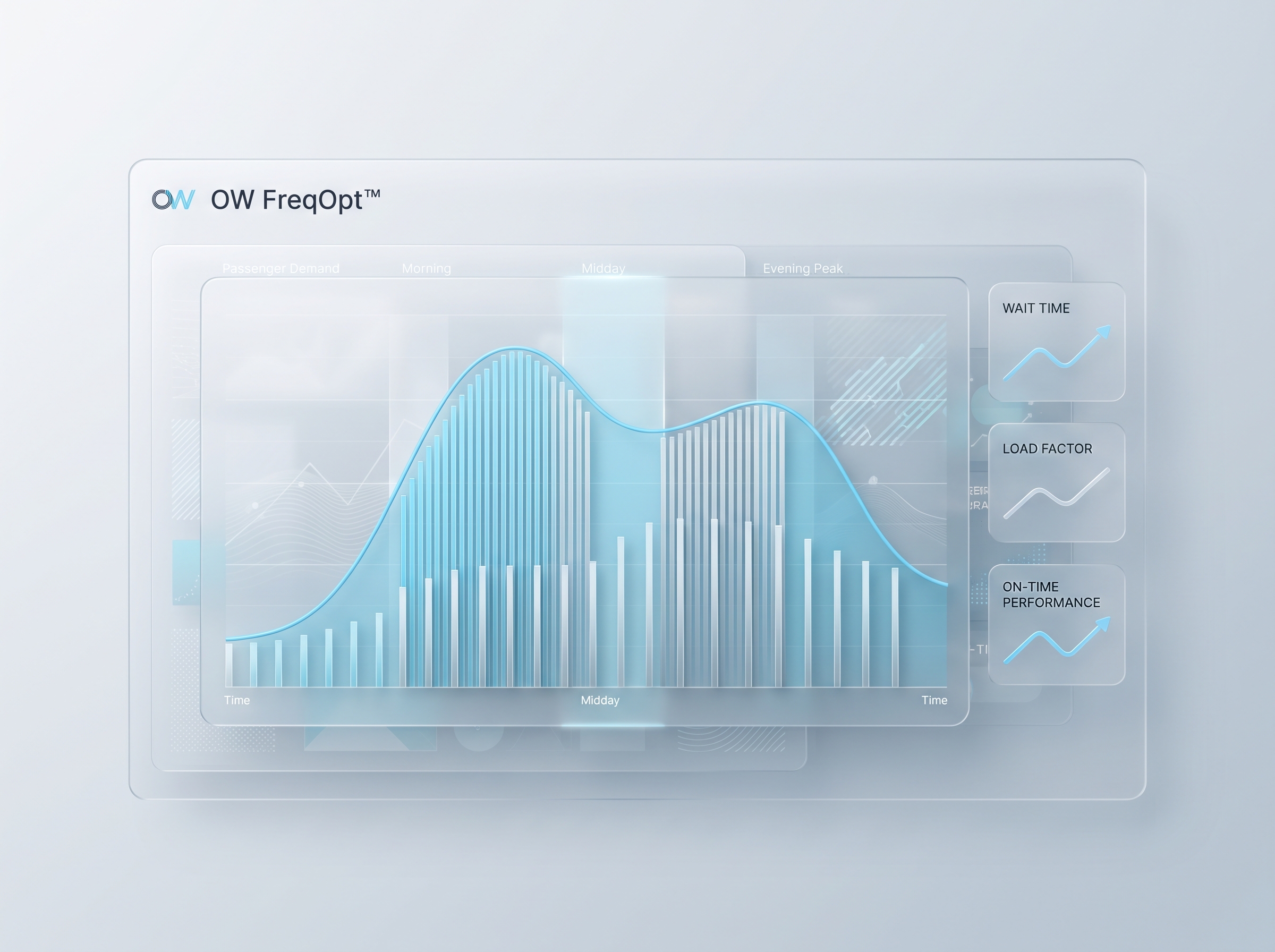
FreqOpt™ helps compare the operational consequences of different service and frequency scenarios.
The objective is not to produce a single, supposedly “perfect” answer.
It is to put options in front of decision-makers that may never have been visible before.
But What If Ants Alone Are Not Enough?
This is where the subject becomes even more interesting.
As problems become larger and more complex, colony-based optimization methods require greater computational capacity and increasingly intelligent search strategies.
This is why learning models are increasingly being combined with colony-based optimization.
The logic is straightforward.
Learning can identify which areas of the solution space appear promising based on previous experience.
Colony-based search can continue exploring alternatives that have not yet been tested.
The combination matters.
Because learning from the past alone is not enough.
Cities change.
Demand changes.
Operations change.
A solution that worked yesterday may not perform the same way tomorrow.
This means that the optimization systems of the future cannot simply predict.
They also need to keep exploring.
Human or Algorithm? That Is the Wrong Debate.
The conclusion here is not:
“Human planners are no longer necessary.”
Quite the opposite.
An algorithm can generate thousands of alternatives.
But it cannot independently determine what a city should value most.
Should the priority be higher ridership?
Lower operating costs?
Greater accessibility?
Lower emissions?
These are not purely mathematical decisions.
They are strategic decisions.
Human expertise defines the context.
Algorithms explore alternatives that humans cannot realistically examine on their own.
In the future of transport planning, one will not replace the other.
Humans will define the objective.
Algorithms will explore the solution space.
Decision-makers will evaluate the outcomes.
This relationship sits at the core of the decision-support approach OW is developing.
Perhaps We Need Less Control — and More Exploration.
Are ants smarter than urban planners?
Probably not.
But they are remarkably good at something we often struggle with.
They do not decide too early that a single solution must be the right one.
They explore alternatives.
They reinforce successful paths.
And when the environment changes, they adapt.
Perhaps that is the real lesson for public transport.
There is no single, permanent “best network” for a city.
Demand changes.
Traffic changes.
Costs change.
Cities themselves change.
The solution must therefore be able to change as well.
The future of public transport planning may not belong to networks designed once and left untouched for years.
It may belong to systems that are continuously tested, measured and re-optimized.
How Many Alternatives Has Your City Never Tested?
Perhaps your existing network is already performing remarkably well.
Or perhaps it is the accumulated result of decisions made years ago, demand patterns that have since changed, and assumptions that are no longer valid.
It is difficult to know through intuition alone.
But it can be tested.
What alternatives exist within your current network that you have simply never explored?
With OW, you can bring together GTFS, AVL, passenger and operational data to test different route, frequency and resource scenarios.
Start your first scenario analysis with OW—and find out whether your current plan is truly the only option.
Related Modules
Used in this piece

Related Posts
Continue with adjacent topics—from mixed-integer programming (MIP) and combinatorial optimization to multi-objective scenario modeling in public transit.

Why Is It So Difficult to Keep Everyone Happy in Public Transport?
Passenger demand and limited operational resources share the same network. The real challenge is not more buses — it is aligning supply with how people actually travel.
Buying Electric Buses Is Easy. Operating Them Optimally Is the Hard Part.
Electrification does not end at procurement. Vehicle assignment, charging schedules and energy constraints must be optimized together — or costs rise quietly every day.