Skip to content

Case Studies & Pilot Implementations

Real-world applications of OW Suite decision intelligence—Governance, Network, Finance, and Sustainability—with methodology grounded in GTFS validation, Mixed-Integer Programming (MIP), deadhead ratio control, and service coverage analytics.

Example Scenario Governance

Citywide Operations & Resource Coordination

System Question

How can limited resources be allocated across the city in a transparent, effective, and coordinated way?

How OW Supports

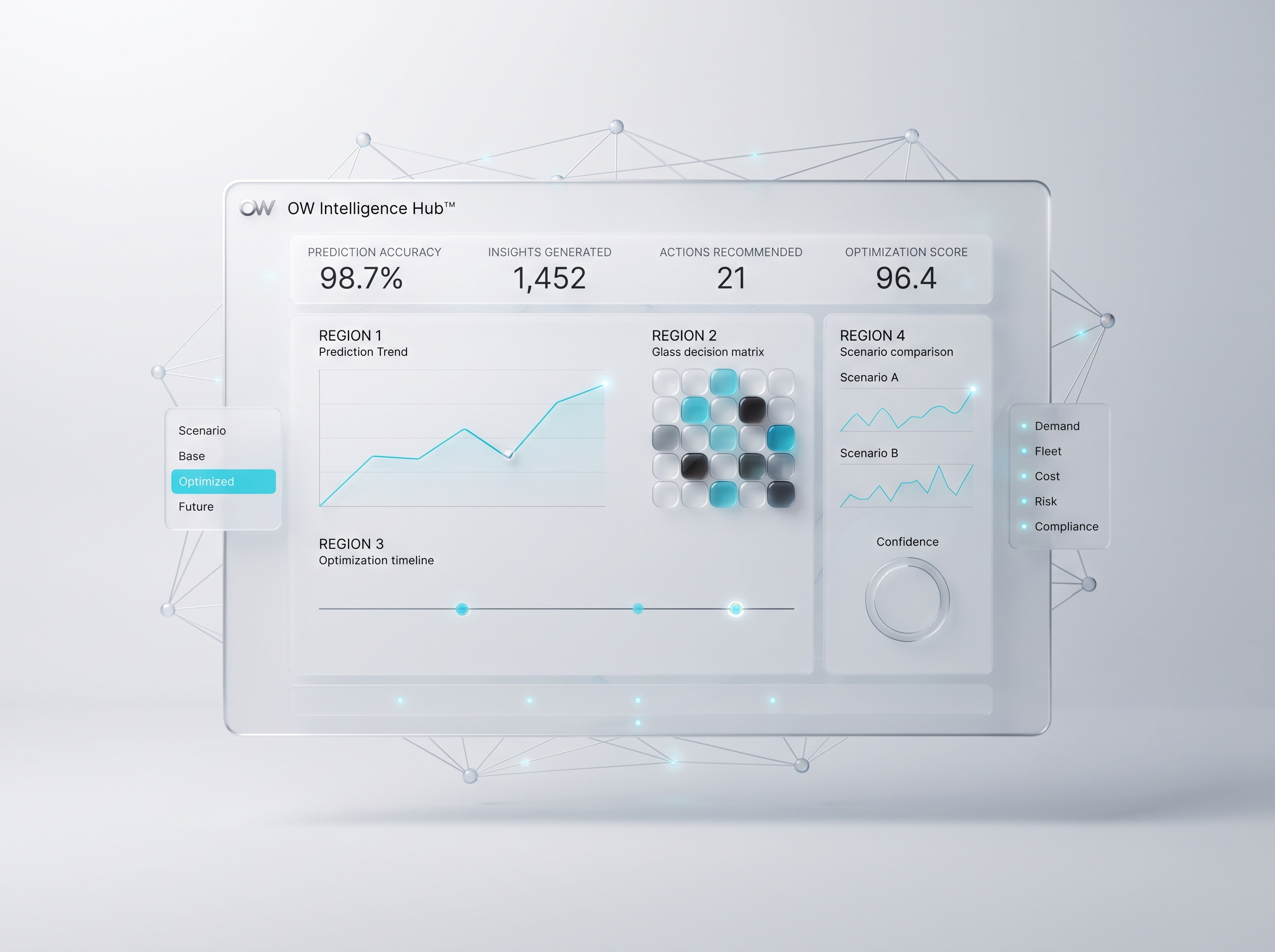
OW integrates fragmented operational data into a shared system model, enabling organizations to understand trade-offs and coordinate actions across governance layers.

The Challenge

Large transit agencies rarely fail because of a single bad timetable—they fail because planning, operations, finance, and maintenance optimize local KPIs that conflict at the system level. Bus, rail, and contracted services often ingest different versions of the truth: stale GTFS snapshots, partial AVL coverage, and reporting spreadsheets that cannot be reconciled with what vehicles actually did on the street.

That fragmentation produces invisible overlap: duplicate coverage on strong corridors while peripheral neighborhoods miss reliable Service Coverage, and deadhead repositioning is treated as an operational detail instead of a budget line item. Without a shared optimization lens, governance forums debate totals (vehicles, trips, euros) instead of decision impact—exactly where Mixed-Integer Programming (MIP) and validated demand-supply models create leverage.

OW's Decision Intelligence Approach

OW establishes a GTFS Validation and data-ingestion gate before any optimization run. Feeds are checked for shape integrity, stop sequencing, calendar coherence, and block continuity so that MIP formulations are not poisoned by silent data defects. Once baseline network behavior is trusted, agencies model cross-mode resource allocation as an MIP with explicit objectives: reduce aggregate deadhead ratio, improve punctuality-sensitive Service Coverage, and respect fleet, crew, and political minimums as hard constraints.

Scenario layers let governance teams stress-test coordinated policies—network restructuring, procurement deferrals, or inter-operator transfers—against the same objective function, so trade-offs are explainable rather than rhetorical. Weekly model refresh cycles supported by GTFS-RT deltas keep the digital twin close to field reality while preserving auditability for public boards.

Key Metrics

MetricBaselineOW optimizedImprovement
Deadhead ratio (system)26–30%17–22%8–12 pts ↓
Service Coverage (equity-weighted)72/10082–88/100+10–16
Cross-mode reporting latency5–10 days<24 hNear real time
Coordinated scenario consensus time8–12 weeks2–4 weeksFaster cycles

View related decision context on Use Cases →

GTFS → MIP

Governance & data fusion layer — GTFS validation → shared MIP core
Example Scenario Network

Public Transport Network Performance

System Question

Why does the transport network underperform — even when planned supply is in place?

How OW Supports

OW replaces static schedules with adaptive, demand-aware optimization models that improve reliability, efficiency, and service quality.

The Challenge

Planners publish timetables that look adequate on paper, yet passengers experience chronic unreliability, crowding pockets, and surprise gaps. The root cause is rarely a lack of vehicles—it is a structural mismatch between where and when demand concentrates and how supply is committed through blocks, interlining, and depot return constraints. Empty kilometers accumulate in the transitions between peaks, during inter-route deadheads, and when layovers are not synchronized with real crowding.

Traditional line-by-line tuning cannot see cross-route dependencies: delaying one trip propagates through terminal capacity, driver arcs, and downstream connections. Service Coverage metrics averaged across the network hide corridors where headway reliability collapses even though nominal frequency is high.

OW's Decision Intelligence Approach

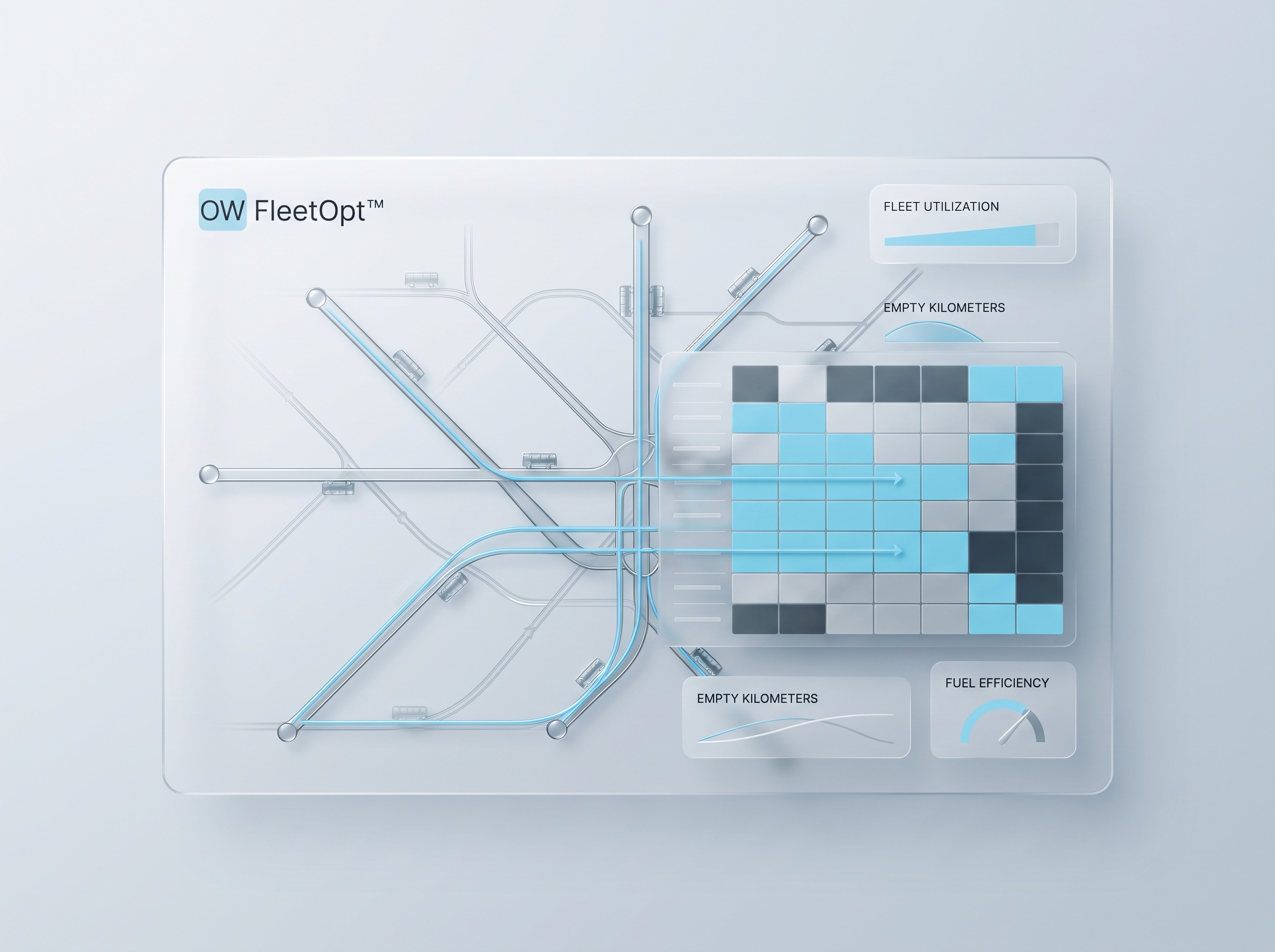
OW models the network as a capacitated, time-expanded flow problem. Mixed-Integer Programming ties trip-building, vehicle circulation, and crew-feasible rotations to minimizing dead mileage while honoring headway, load, and OTP targets. GTFS Validation ensures route geometry and stop times align with observed speed profiles so deadhead and running times in the MIP reflect operational physics, not wishful scheduling.

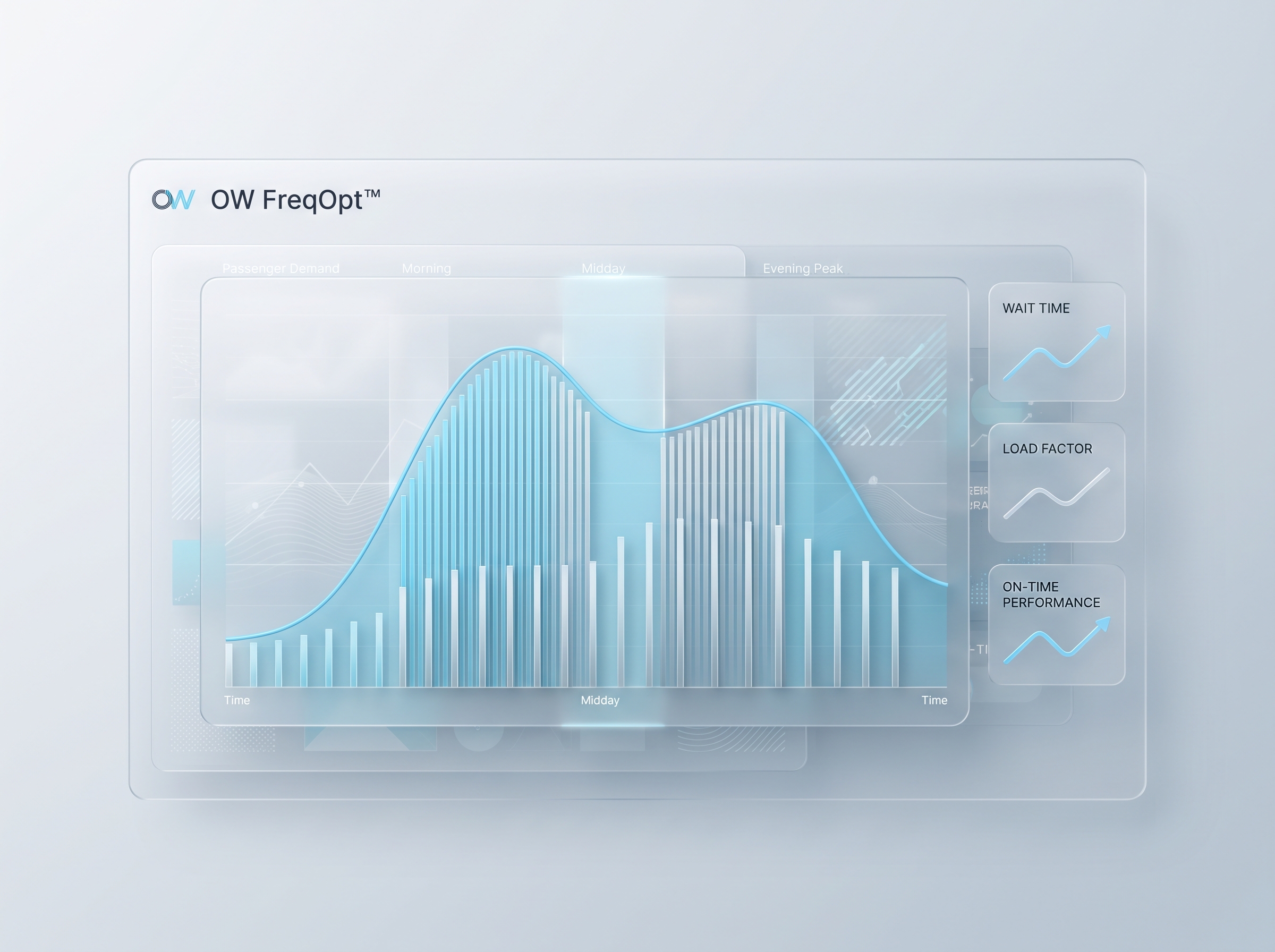
Demand-aware frequency and micro-adjustments use smart-card or APC-informed load curves to reposition slack where it prevents crowding instead of where tradition places it. Continuous monitoring of deadhead ratio by depot, route family, and time-of-day exposes the structural drivers that spreadsheets miss, turning network redesign into an empirical optimization exercise instead of a political debate.

Key Metrics

MetricBaselineOW optimizedImprovement
Deadhead ratio (peak/off-peak)24–32%15–20%9–12 pts ↓
Headway regularity (cv)0.38–0.450.22–0.30Stabilized
Crowding exceedance hours100% (baseline)65–78%22–35% ↓
OTP / on-time performance78–82%86–92%+6–10 pts

View related decision context on Use Cases →

GTFS → MIP

Network flow — demand signals → MIP trip graph → dead mileage minimization

Example Scenario Finance

Budget & Cost Dynamics

System Question

Which costs are structural, and which are driven by operational choices?

How OW Supports

OW shifts budget discussions from totals to decision impact, helping organizations understand how choices translate into costs.

The Challenge

Finance teams see fuel, labor, and maintenance as line items; operations sees them as outcomes of scheduling decisions. Without a causal bridge, budget cuts become blunt (fewer trips everywhere) instead of surgical (remove structural dead mileage while preserving Service Coverage). Similarly, savings from vendor changes can evaporate when hidden deadhead hours reappear in overtime or fuel.

Auditors and boards ask for evidence. Spreadsheets rarely attribute marginal cost to a specific timetable pattern, interlining choice, or depot assignment—yet those are exactly the levers Mixed-Integer Programming can quantify when the objective and constraints encode real operating rules.

OW's Decision Intelligence Approach

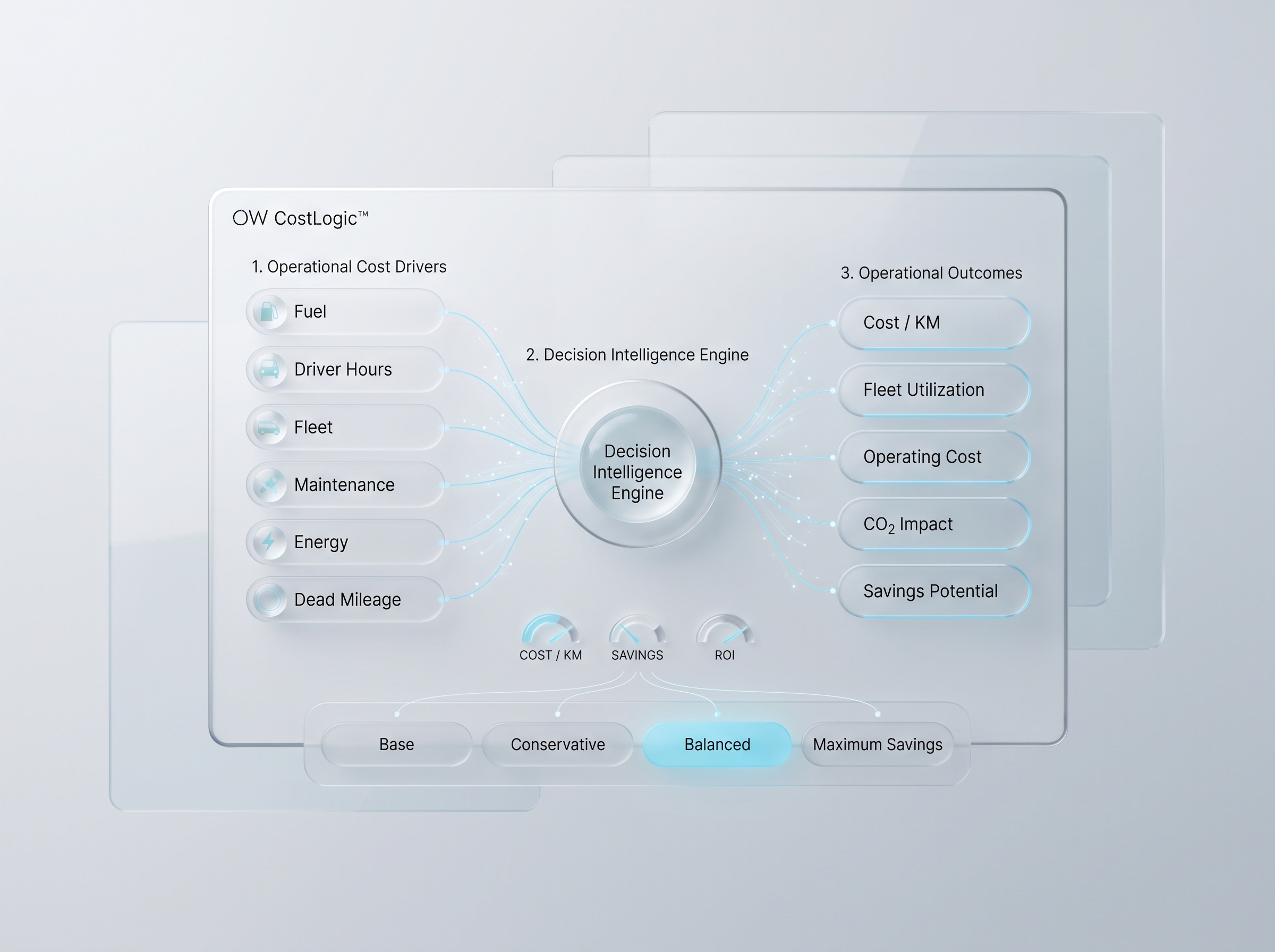
OW CostLogic™ and optimization layers separate baseline structural commitments (minimum service rules, collective agreements, fleet ownership) from decision-derived OPEX: deadhead hours, peak vehicle requirement, fuel from empty repositioning, and maintenance cycles triggered by marginal kilometers. Every scenario run produces a consistent cost attribution tied to GTFS-validated vehicle trajectories, not inferred averages.

MIP shadow prices on tight constraints (fleet caps, max peak buses, terminal capacity) translate into finance-ready narratives: which euro of savings is robust under demand uncertainty versus which requires risky service degradation. This is how agencies move from debating totals to debating trade surfaces—Service Coverage versus spend, reliability versus fleet count—with transparent sensitivity to GTFS data quality.

Key Metrics

MetricBaselineOW optimizedImprovement
OPEX attributable to dead mileage9–14%5–8%4–6 pts ↓
Peak vehicle requirement100%92–97%3–8% ↓
Cost per revenue hour100%88–94%6–12% ↓
Scenario ROI clarityQualitativeQuantified (MIP)Auditable

View related decision context on Use Cases →

GTFS → MIP

Cost attribution — validated vehicle traces → OPEX decomposition

Example Scenario Sustainability

Environmental Performance & Carbon Reduction

System Question

How do operational choices influence environmental outcomes?

How OW Supports

OW aligns operational optimization with climate and sustainability objectives by making environmental impact a measurable system outcome.

The Challenge

Cities publish climate targets, but transit emissions are embedded in operational mechanics: unnecessary dead mileage, poor load factors, and diesel peaks that could be smoothed with better frequency carving. Without coupling emissions models to optimization, sustainability becomes a reporting exercise detached from dispatch and planning levers.

Service improvements can accidentally raise energy use if additional peak buses are thrown at crowding without rebalancing deadhead. True progress requires co-optimizing Service Coverage, reliability, and carbon intensity using the same validated GTFS-AVL foundation—so sustainability officers and COOs negotiate on one digital twin.

OW's Decision Intelligence Approach

OW attaches emission factors and energy-use curves to MIP decision variables: vehicle type, trip length, idle time, and depot pull-outs. Objectives can be scalarized or solved as multi-objective problems, Pareto-fronting the trade-off between crowding relief and CO₂ per passenger-kilometer. Deadhead ratio reduction directly cuts excess VKT, while improved loads on remaining trips raise passenger-km per liter equivalent.

GTFS Validation prevents optimistic routing that understates VKT; AVL reconciliation grounds electrification or H2 readiness scenarios in observed elevation and stop-go patterns. Reporting packages align with municipal climate accounting so each accepted scenario documents not only OTP and Service Coverage deltas but also forecasted emission ranges with confidence bands.

Key Metrics

MetricBaselineOW optimizedImprovement
CO₂ per revenue vehicle-km100%88–93%7–12% ↓
Excess VKT from deadhead100%72–85%15–28% ↓
Passenger-km per energy unit100%108–118%Efficiency ↑
Climate scenario audit trailAd hocGTFS-linkedTraceable

View related decision context on Use Cases →

GTFS → MIP

Carbon-aware optimization — energy curves inside the MIP objective