15 min read
Electric Bus Scheduling: Why Charging and Battery Constraints Must Be Planned Together

Written by Dr. Ümit Kuvvetli
Founder & Chief Optimization Scientist
An electric bus timetable is not a diesel timetable with charging slots added. It is an energy plan that happens to carry passengers.
Every departure, vehicle assignment and layover affects how much energy a bus consumes, when it can recharge and whether it will be ready for its next trip. A schedule that looks efficient on paper may become impractical when battery limits, charger availability and depot capacity enter the picture.
At OW, we help public transport operators make better planning decisions by understanding how fleet, scheduling and operational constraints interact.
This article builds on our earlier piece on why electric bus operations require a different planning approach. Read it here →
1. Energy Consumption Is More Complicated Than It Looks
Electric bus energy consumption is not a fixed number per kilometre. It changes with route characteristics, traffic conditions, passenger loads, temperature and auxiliary systems such as heating and air conditioning.
Consider a modelled route in Ankara. With a 500-metre stop spacing and a 3% uphill gradient at 20 km/h, reported consumption was approximately 1.52 kWh/km for an empty bus and 1.79 kWh/km with 25 passengers. When stop spacing was reduced to 100 metres, consumption approached 5.5 kWh/km under the study's modelled conditions, including auxiliary loads.
The difference matters. A route with frequent stops, steep gradients and heavy passenger demand may require a very different energy budget from a route of similar length with smoother operating conditions.
Weather adds another layer of complexity. In hot climates, air conditioning can significantly increase energy consumption, including while a bus is stationary. In colder regions, cabin heating and battery performance can make winter operations particularly demanding.
For operators, this means basing fleet plans on route-specific energy estimates rather than relying on a single average consumption figure.
2. Timetables, Vehicle Assignments and Charging Must Work Together
Traditional bus planning often treats timetable design, vehicle allocation and depot operations as separate tasks. For electric fleets, that separation can create costly problems.
A vehicle block is the sequence of trips assigned to a single bus during an operating day. For a diesel bus, the main question is whether the vehicle can complete its assigned trips and return to the depot. For an electric bus, planners must also consider whether the battery has enough energy for each trip and whether sufficient charging time is available between assignments.
Imagine a bus completing a demanding morning peak. It may have enough energy to finish its next trip but not enough to complete the following one. A charging opportunity might exist between those trips, yet the layover could be too short, the charger could already be occupied, or the bus might be parked where it cannot reach an available charging point.
A timetable can therefore be operationally feasible for a conventional fleet while being impossible to execute with the same number of electric buses.
An integrated approach considers three decisions together:
- Timetable planning: When and where must each trip operate?
- Vehicle assignment: Which bus should perform each trip?
- Charging optimization: When, where and how much should each bus charge?
Optimizing these decisions jointly can reveal solutions that sequential planning misses. In certain theoretical problem instances, a non-integrated approach can require up to three times the fleet of an optimized integrated plan. This is a theoretical upper bound, not an expected real-world outcome.
The practical objective is to create a timetable and vehicle plan that can actually be operated with the available energy, charging time and infrastructure — not simply to fit charging slots around an existing schedule.
3. Fleet Size, Battery Capacity and Charging Infrastructure Are Connected
Battery capacity, fleet size, charger availability and depot layout are often evaluated independently. In practice, each affects the others.
A larger battery may allow a bus to complete more trips without charging, but it also adds cost and weight. More chargers can create flexibility, but only if the depot has enough electrical capacity and vehicles can physically access them. Adding buses may solve a scheduling problem while increasing capital and operating costs.
Research examining electric bus operations at Paris–Charles de Gaulle Airport found that optimized trip assignments reduced the required battery capacity per bus by nearly 20% compared with a direct conversion of the existing schedule, for the same fleet size under the study's assumptions.
The lesson is not that every operator can reduce battery capacity by 20%. It is that better scheduling can change the amount of battery capacity and charging infrastructure an operation actually needs.
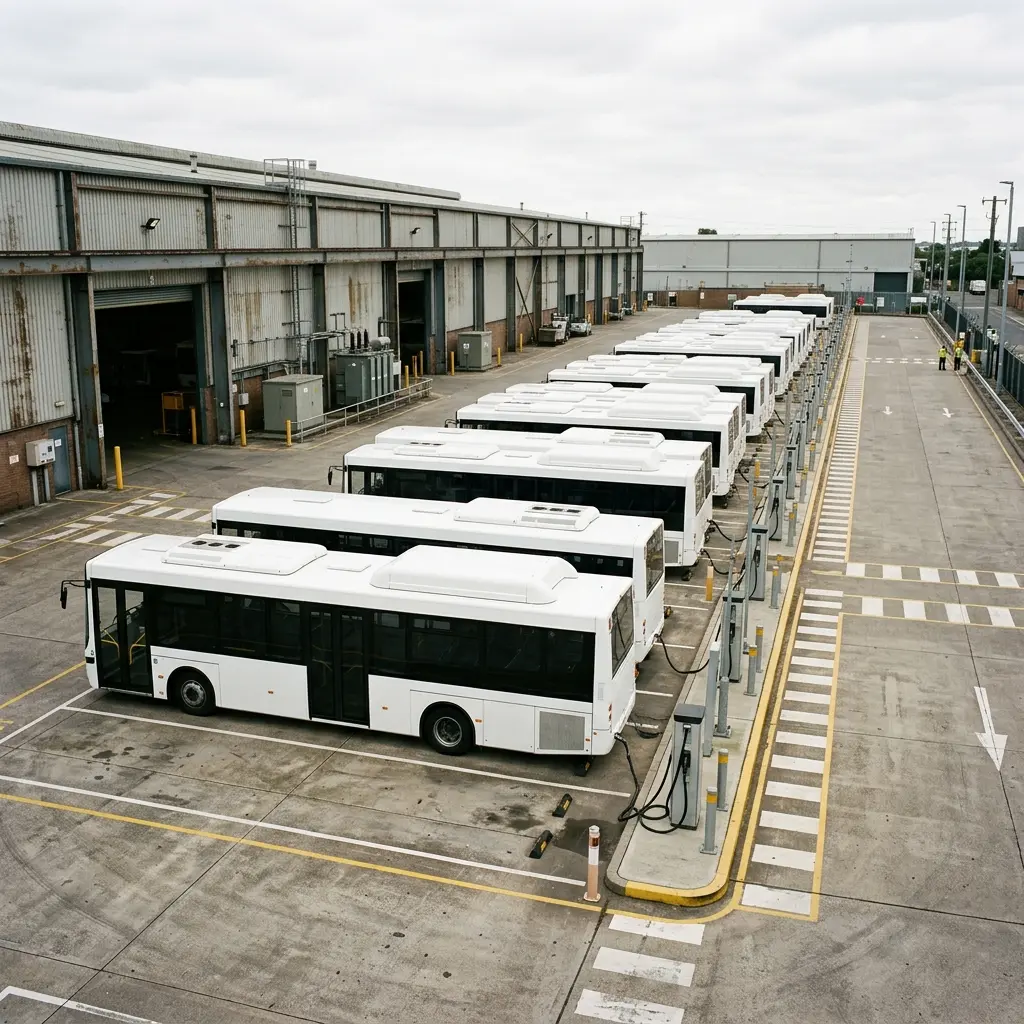
Depot design is equally important. Charger locations, parking order, vehicle movements and available grid capacity can determine whether a theoretically valid charging plan works in practice. A bus may have a charging window available but still be unable to use it if another vehicle blocks access to the charger.
Charging strategies should therefore be evaluated alongside vehicle blocks, battery requirements and depot constraints. Where spare capacity exists, sharing charging infrastructure across vehicles or operating periods may also improve utilization.
For organizations planning new depots or fleet electrification, the key is to assess vehicles, batteries and charging infrastructure as parts of the same operating system.
4. Electricity Prices and Battery Health Affect Real Operating Cost
The cheapest charging plan is not necessarily the one that charges every bus as quickly as possible.
Electricity tariffs can vary by time of day. Charging during lower-price periods may reduce energy costs, but those periods do not always align with the operational windows available to buses. Charging too early may occupy a charger unnecessarily; charging too late may leave insufficient energy for the next departure.
Battery degradation adds another consideration. Frequent high-power charging and repeated deep discharge can affect battery health, depending on the battery chemistry, temperature and charging conditions. A plan that minimizes today's electricity bill may not minimize the fleet's total cost over its useful life.
A cost-aware charging strategy considers:
- Electricity prices and available charging windows.
- Battery state of charge (SoC), meaning the percentage of usable battery capacity remaining.
- Energy requirements for upcoming trips.
- Charger power and availability.
- Battery degradation and long-term replacement costs.
- Service reliability and the consequences of a bus being unavailable.
Some optimization studies combine battery sizing, charger placement, charging schedules and battery degradation in a single model. One network-level study reported a 37.88% reduction in total system cost under its modelled assumptions. As with other optimization results, this reflects the specific system and conditions evaluated rather than a guaranteed saving for every operator.
The important question is not simply when electricity is cheapest. It is how to balance energy costs, battery life, infrastructure investment and service requirements over the entire operation.
5. The Plan Must Work on Difficult Days, Not Just Average Ones
A charging strategy that works under average conditions may fail when traffic congestion increases energy consumption, temperatures move outside the expected range or a charger becomes unavailable.
These disruptions can propagate through the operating day. A delayed bus may arrive at a charging point later than planned, receive less energy than expected and then depart for its next trip with a reduced battery reserve. One disruption can affect subsequent trips and vehicle assignments.
Planning should therefore account for operational uncertainty rather than relying entirely on ideal conditions.
Depending on the network, this may involve:
- Depot charging: Charging buses at the depot, commonly during overnight or other extended layovers.
- Opportunity charging: Charging at terminals or selected stops during the operating day.
- Battery swapping: Replacing a depleted battery with a charged one, where the vehicles and infrastructure support this approach.
- Operational reserves: Allowing for realistic variation in energy consumption, charging time and vehicle availability.
These approaches are not interchangeable. Their suitability depends on route length, service frequency, available layover time, battery characteristics, infrastructure costs and the operational environment.
A robust plan should remain workable when conditions differ from the forecast, while making the cost of additional resilience visible to decision-makers.
In practice, the test is simple: can the plan maintain the required service when actual operating conditions differ from the assumptions used to build the timetable?
How We Approach Electric Fleet Planning
We look at electric bus operations as a connected planning problem rather than a collection of independent decisions. This comes down to three questions.
Can the required service be delivered?
The timetable, vehicle assignments, battery limits and charging windows must work together to provide the planned service.
What infrastructure does the operation need?
Energy demand, battery capacity, charger availability, depot layout and grid constraints should be assessed in relation to the actual operating plan.
What is the best operational trade-off?
Operators need to understand the implications of different choices for fleet size, energy costs, infrastructure investment, battery life and service reliability.
The objective is to help decision-makers evaluate feasible alternatives and understand the trade-offs behind them. Any expected operational or financial improvement should be assessed against the operator's existing service, data and constraints.
Why This Matters for Bus Manufacturers and Charging Providers
Electric bus manufacturers and charging infrastructure providers are making decisions that shape public transport operations for years. Vehicle specifications, battery configurations, charging power and depot requirements all influence how a fleet can be scheduled.
Yet a technically suitable vehicle or charger does not automatically produce an efficient operating system. Its value depends on how the technology fits the network's routes, timetables, fleet requirements and daily operating conditions.
A planning-led approach can help operators and technology providers evaluate configurations against real operational needs before committing to major investments.
If you are developing an electric fleet, preparing a procurement process or evaluating charging infrastructure, talk to OW.
Frequently Asked Questions
What is electric bus scheduling optimization?
Electric bus scheduling optimization determines how trips, vehicles and charging activities should be coordinated so that the required service can be delivered within battery, timetable, infrastructure and cost constraints.
Can an existing diesel bus timetable be used for electric buses?
It can serve as a starting point, but it should not be assumed to work unchanged. Electric buses introduce energy limits, charging windows and infrastructure constraints that may require adjustments to vehicle assignments, layovers or the timetable itself.
How does charging affect fleet size?
Charging takes time and requires accessible infrastructure. If a bus cannot recharge sufficiently between trips, another vehicle may be needed to cover the service. Coordinating trip assignments and charging can sometimes reduce the additional fleet requirement.
Why does electric bus energy consumption vary so much?
Energy consumption depends on factors such as route gradient, stop frequency, traffic, passenger load, temperature and auxiliary systems. Route-specific energy estimates are therefore more useful than relying exclusively on a fleet-wide average.
How can scheduling help protect battery health?
Scheduling can influence charging frequency, charging power, depth of discharge and the time available for charging. Considering these factors alongside electricity prices and service requirements can help operators evaluate long-term battery costs.
What should be considered when choosing between depot and opportunity charging?
The decision depends on route characteristics, layover duration, service frequency, battery capacity, charger power, depot and terminal infrastructure, grid availability and total cost. The most suitable strategy is the one that fits the complete operating plan.
Conclusion: Plan the Whole System
Electric bus operations cannot be optimized by treating the timetable, fleet and charging infrastructure as separate decisions.
Energy consumption changes across routes and conditions. Vehicle assignments determine when buses can charge. Charger availability affects the timetable, while electricity prices and battery degradation influence long-term cost. The challenge is to make these decisions work together.
The timetable, the fleet and the charging strategy need to work as one system.
That is the foundation of effective electric bus planning — and a critical step towards reliable, cost-conscious public transport electrification.
If you are planning an electric fleet, preparing a procurement process or evaluating charging infrastructure, talk to OW. You can also explore OW's solutions to learn more about data-driven public transport planning and optimization.
Related Modules
Used in this piece


Related Posts
Continue with adjacent topics—from mixed-integer programming (MIP) and combinatorial optimization to multi-objective scenario modeling in public transit.

Why Is It So Difficult to Keep Everyone Happy in Public Transport?
Passenger demand and limited operational resources share the same network. The real challenge is not more buses — it is aligning supply with how people actually travel.
Buying Electric Buses Is Easy. Operating Them Optimally Is the Hard Part.
Electrification does not end at procurement. Vehicle assignment, charging schedules and energy constraints must be optimized together — or costs rise quietly every day.